
CryptoPilot — Turns live market data into ensemble-model trading decisions, executed within hard risk limits.
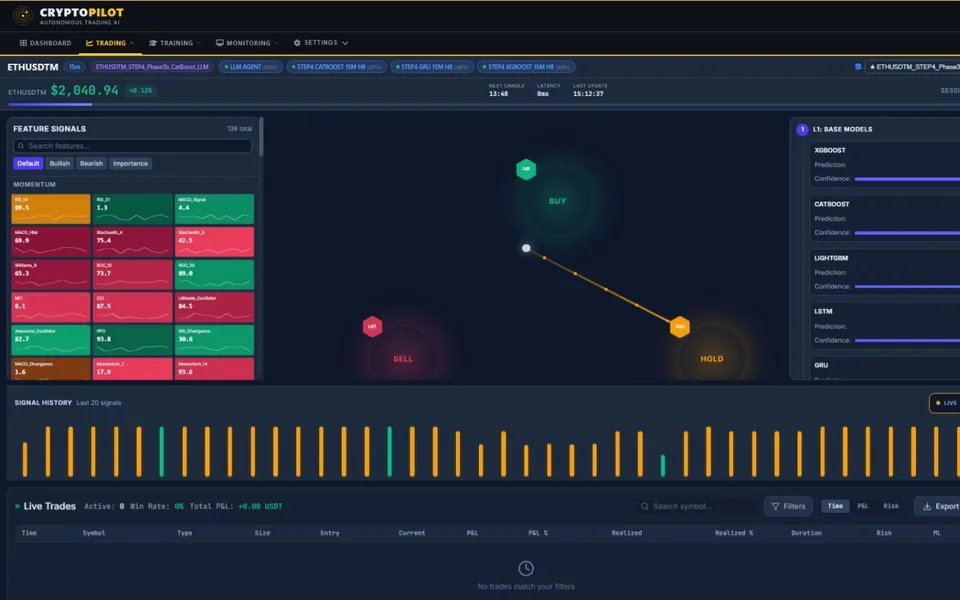
An autonomous trading platform. Live market data feeds 138 technical features into an ensemble of gradient-boosted and deep sequence models; an LLM agent adds market context, and trades execute within hard risk limits.
The problem
Making reliable automated decisions in a market that moves in seconds: sub-second signal processing, consensus across several models, protection against false signals and model drift, and staying connected through exchange rate limits and dropped connections.
What we built
A three-layer pipeline — signals, ensemble prediction, execution — with weighted consensus scoring across XGBoost, CatBoost, LightGBM, LSTM and GRU models, an LLM agent for context, automatic position sizing and stop-losses, and a live dashboard for P&L, signal history and model confidence.
What it does today
Runs around the clock: live signals from 138 features, consensus across five model types plus an LLM agent, automatic position sizing and stop-losses, with every signal and trade tracked on a live dashboard.
— Under the bonnet
What makes a product like this hard to build
- 01
Hundreds of signals, every candle
Live market data is turned into 138 technical features on every candle, on schedule, with no gaps. A late or missing feature silently changes every prediction downstream, so ingestion, back-fill and validation have to be relentless.
- 02
An ensemble that agrees with itself
XGBoost, CatBoost, LightGBM, LSTM and GRU models each give a prediction and a confidence. Weighting them into one decision — and knowing when they disagree too much to act — is where most of the engineering goes.
- 03
Training without fooling yourself
Trading models look brilliant on data they've already seen. Walk-forward training, leakage checks and replaying past markets as if live are what separate a model that backtests well from one that trades well.
- 04
An LLM in the loop, not in charge
An LLM agent adds market context to each decision, but it sits inside hard risk limits: position sizing, stop-losses and kill switches the model can't override.
- 05
Always-on execution
Exchange APIs rate-limit, websockets drop and orders part-fill. Workers have to run around the clock, reconnect cleanly and keep the live P&L, positions and signal history consistent.
— Estimated build cost
What a build like this costs
£460,000–£670,000
Algorithmic trading platform · indicative range for a comparable build
Sized from the core codebase we built: 609k lines of production code (299k ML), 149 database tables.
A product like CryptoPilot is a bespoke build, not a template: most of the cost is in the hard parts above, plus testing against real data before anyone relies on it. Where your version lands in the range depends on the factors listed here. You get a fixed price once scope is agreed — usually after a short discovery sprint. Hosting and AI model usage are billed at cost on your own accounts.
Get an estimate for yoursWhat moves the price
- Number of markets, exchanges and timeframes traded
- Size of the model ensemble and how often it's retrained
- Depth of backtesting and live-replay tooling
- Risk controls, monitoring and alerting
- Real-time dashboards for signals, trades and model health
Built with
- Python
- XGBoost
- CatBoost
- LightGBM
- TensorFlow (LSTM/GRU)
- OpenAI
- PostgreSQL
- Redis
- WebSockets
- Playwright
Designed, built and run by our Manchester team. Want something similar? See our AI development services, AI automation and pricing.